
Personalised Experience


Why adapting to your child’s learning style and interests changes everything
Imagine being handed a pair of shoes that don’t quite fit and being told to walk in them all day, every day, for years. They’re not terrible — they’re just not your size. You can manage. But you’re uncomfortable, you’re slower than you should be, and by the end of the day your feet hurt. Now imagine someone hands you a pair that fits perfectly. Suddenly you’re not just walking — you’re running.
That’s the difference between one-size-fits-all education and a personalised experience. And it’s one of the most extraordinary things about home education — you get to find the shoes that fit.
Every Child Learns Differently — And That’s Not a Problem to Solve
We talk a lot about learning styles, and sometimes the conversation gets a bit overcomplicated. But the core idea is simple: children take in and make sense of the world in different ways. Some need to see things. Some need to hear them. Some need to touch, build, and move. Some need to talk things through. Most need a mixture, and the mixture changes depending on the subject, the day, and their mood.
In a classroom of thirty children, meeting each of those individual needs is almost impossible. Teachers do their best, but the reality is that lessons are designed for the middle ground. If your child doesn’t learn in the middle ground — if they’re a hands-on thinker in a sit-and-listen world, or a big-picture dreamer in a step-by-step system — they can spend years feeling like they’re the problem, when actually it was just the wrong shoes.
At home, you don’t have that limitation. You have one child (or a small number) and you can shape the learning around them, rather than shaping them around the learning. That’s not a luxury. It’s a game-changer.
What Personalised Learning Through Play Actually Looks Like
Personalising your child’s education doesn’t mean creating a bespoke curriculum from scratch or spending hours planning elaborate activities. Most of the time, it simply means paying attention to how your child naturally engages with the world and leaning into that.
The child who thinks in pictures might struggle with a page of written instructions but come alive when you hand them a diagram, a map, or a set of images to work from. They might learn spelling more easily by visualising words in colour, understand history better through timelines they can see, or grasp science concepts through drawing and labelling rather than reading and writing. Give them sketch pads, whiteboards, mind maps, and visual puzzles and watch what happens.
The child who thinks with their hands needs to touch, make, and build. These are often the children who get labelled as “fidgety” or “unable to concentrate” in a traditional setting, when actually their concentration is extraordinary — it just needs something physical to anchor to. Let them learn maths with real objects, explore science through experiments and construction, understand grammar by physically moving word cards around. Their intelligence lives in their fingers, and when you honour that, they thrive.
The child who thinks in stories might find bare facts hard to hold onto but can remember anything woven into a narrative. History comes alive when it’s told as a story rather than a list of dates. Science makes sense when it’s framed as a mystery to solve. Even maths can become an adventure if you set it in the right context. These children often have a gift for language, imagination, and empathy — and play that involves role-play, storytelling, and creative writing is where they shine.
The child who thinks by doing learns best when they can see the real-world purpose behind what they’re studying. They want to know why this matters and what they can do with it. These are the children who will happily learn about measurements if they’re building a shelf, master percentages if they’re planning how to spend their birthday money, or research a topic thoroughly if it’s something they genuinely want to know. Connect learning to life, and they’re all in.
The child who thinks out loud processes ideas by talking about them. They might seem like they’re not listening, and then surprise you with a detailed question ten minutes later. They often learn well in groups, through discussion, or by explaining things to someone else. If you’ve ever noticed your child suddenly understand something the moment they try to teach it to a sibling or a pet, you’ve seen this in action.
Following Their Interests — The Secret Ingredient
There’s a moment that happens in almost every home educating family, and it’s magical. It’s the moment your child gets hooked on something. Really hooked. Maybe it’s dinosaurs, or space, or Minecraft, or baking, or Ancient Egypt, or how engines work, or a particular book series. Whatever it is, they can’t get enough.
This is your golden thread. Pull it.
A child who is passionate about something will learn more deeply and willingly through that interest than through any structured programme you could buy. The trick is spotting the learning opportunities within the passion and gently weaving them in.
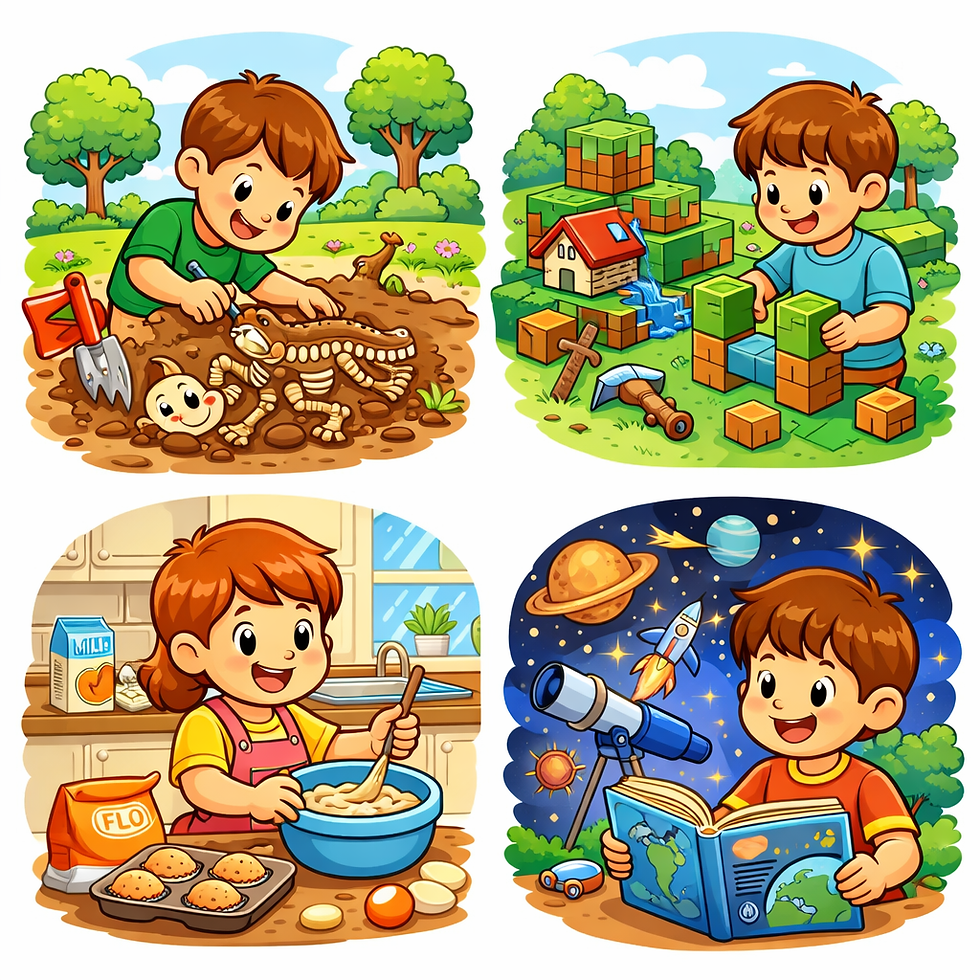
Dinosaurs? That’s biology, geology, geography, history, classification, measurement (how big was a T-Rex compared to our house?), creative writing (diary of a palaeontologist), art, and research skills — all wrapped up in one magnificent obsession.
Minecraft? That’s geometry, planning, resource management, creativity, problem-solving, coding, storytelling, and collaboration. The amount of maths a child does while playing Minecraft without realising it would make your head spin.
Baking? That’s fractions, measurement, following instructions, science (what makes a cake rise?), history (where did this recipe come from?), geography (where do these ingredients grow?), and the life skill of feeding yourself well.
When you follow your child’s interests, you’re not taking a shortcut. You’re taking the most effective route there is. Because a child who is motivated by genuine curiosity will always learn more than one who is simply doing as they’re told.
What About the Things They Don’t Like?
This is the question, isn’t it? It’s all very well following their passions, but what about the subjects they resist? What about the skills they need but don’t enjoy?
This is where personalisation and play work together beautifully. Because the answer isn’t to force the thing they don’t like — it’s to find a different way in.
A child who hates writing might love dictating stories into a voice recorder.
A child who resists maths on paper might happily do it when it’s a physical game or a real-life challenge.
A child who won’t read fiction might devour non-fiction about their favourite topic.
A child who refuses a workbook might create their own quiz for you to take instead.
The content stays the same. The approach changes. And because you know your child better than anyone else on the planet, you’re the best person to find the approach that works.
You Don’t Need to Get It Right Every Time
Here’s something freeing: personalising your child’s learning is not about perfection. You don’t need to identify their exact learning style and create a flawless programme around it.
Children are complicated, changeable, surprising humans.
What works brilliantly on Monday might fall flat on Wednesday.
What they loved last month might bore them today.
That’s fine. Personalised learning is a conversation, not a fixed plan. It’s about staying curious about your child — noticing what makes their eyes light up, what makes them switch off, what helps things click. Over time, you build up a picture, and that picture becomes your greatest teaching resource.
You’ll get it wrong sometimes. You’ll plan something you were sure they’d love and they’ll shrug at it. You’ll stumble onto something accidentally that turns into the best learning experience of the month. That’s not failure — that’s parenting. And it’s also, if we’re honest, quite a lot of fun.
The Bigger Picture
When a child experiences learning that’s been shaped around who they are — their strengths, their interests, their way of thinking — they don’t just learn the subject matter more effectively. They learn something much more important: that who they are is enough.
They learn that their way of thinking isn’t wrong, just different. They learn that their passions have value. They learn that they’re not broken because they don’t fit a mould that was never designed for them in the first place.
And that kind of self-knowledge — that deep, quiet confidence in who you are and how you learn — is worth more than any grade, any certificate, any tick on a curriculum checklist. It’s the foundation for a life of learning, growing, and believing in yourself.
A personalised experience, adapted through varied play, doesn’t just teach your child what they need to know. It teaches them that they matter. And there’s no lesson more important than that.


Comments